
Sustainability is becoming an increasingly important consideration for businesses across the UK, including the funeral industry. As more people look for ways to reduce their environmental impact, funeral directors have an opportunity to offer more sustainable options while making practical improvements to their everyday operations.
From eco-friendly funeral products to more efficient transport and carbon offsetting, there are several ways funeral directors can take steps towards a more sustainable future.
Whether you are looking to introduce new services for families or reduce your business’s carbon footprint, here are some practical ways to make your funeral home more environmentally friendly.
1. Offer Optional Eco-Friendly Funeral Products and Services
One way to become more sustainable is to give families the option of choosing environmentally conscious funeral products and services. These choices can help families honour their loved ones in a way that reflects their values, while offering a more personal approach to saying goodbye.
Natural Burials
Natural burials are an alternative to traditional burial practices, allowing people to be laid to rest in natural surroundings, often with a focus on protecting the local environment.
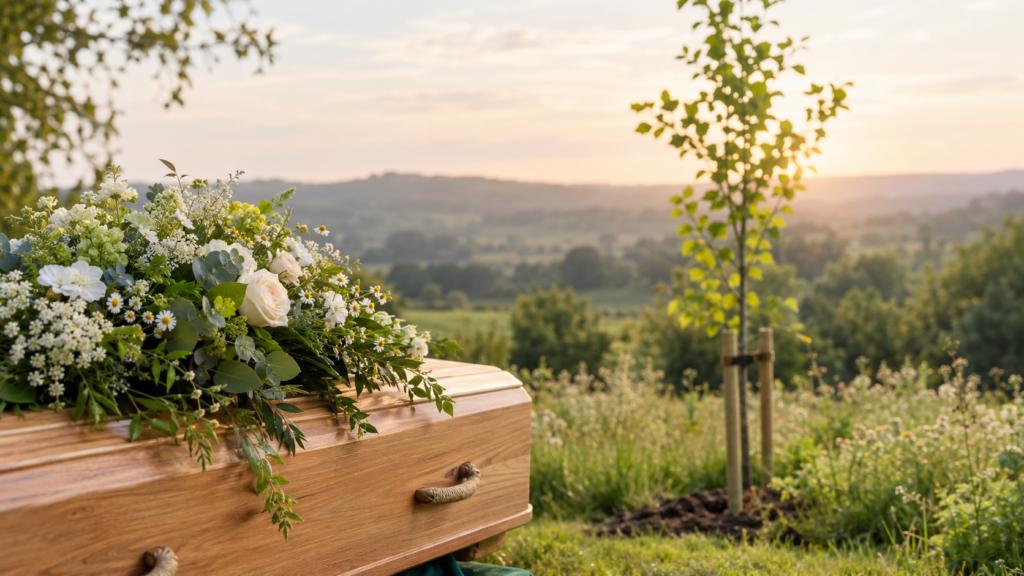
Working with a natural burial ground can allow funeral directors to offer this option to families who want a more environmentally conscious farewell. Depending on the site’s requirements and the choices made, natural burials can involve biodegradable coffins, limited use of non-biodegradable materials and less intensive grave preparation.
Some natural burial sites also manage their land to encourage biodiversity, creating habitats for local wildlife and wildflowers.
Funeral directors can research natural burial grounds in their area and build relationships with suitable providers to make these options more accessible to families.
Eco-Friendly Coffin Options
Traditional coffins are available in a range of materials and finishes, but there are also alternatives for families who want to consider the environmental impact of their choice.
Options may include coffins made from sustainably sourced wood, wicker, bamboo, cardboard or other materials designed to have a lower environmental impact.
The most suitable option will depend on the type of funeral, the family’s preferences and the requirements of the burial ground or crematorium. For example, some materials may be more suitable for burial than cremation.
By working with suppliers who offer a range of environmentally conscious products, funeral directors can give families more choice without compromising on the personal nature of the funeral.
Eco-Friendly Floral Tributes
Flowers play an important role in many funerals, providing a personal way for family and friends to pay tribute to someone they have lost. However, traditional floral arrangements often use floral foam, which is typically made from plastic and does not readily biodegrade.
An alternative is to offer floral tributes created without traditional floral foam. Florists can use techniques such as reusable structures, natural materials and other methods of supporting and arranging flowers.
Funeral directors could work with a local florist who offers these alternatives, allowing families to request more environmentally conscious arrangements, including wreaths, coffin sprays and other floral tributes.
Choosing locally sourced, seasonal flowers where possible may also help reduce the environmental impact associated with transportation and production.
Offering these options gives families the opportunity to make a thoughtful choice without losing the personal meaning that flowers can bring to a funeral.
2. Make Everyday Operations More Efficient
Sustainability is not just about the products and services offered to families. Small changes to everyday operations can also help funeral directors reduce waste, energy use and emissions.
Reduce Unnecessary Travel
Funeral directors rely on vehicles for a range of essential tasks, from transferring the deceased and attending funerals to visiting families and collecting supplies.
Although transport is an unavoidable part of the industry, there may be opportunities to reduce unnecessary journeys.
Planning appointments and collections more efficiently, combining trips where practical and reviewing routes can help reduce mileage and fuel consumption. Regular vehicle maintenance and encouraging efficient driving habits can also help improve fuel efficiency.
For funeral directors operating across several branches, reviewing how journeys are organised between locations may reveal further opportunities to save time and reduce emissions.
Improve Energy Efficiency in Funeral Homes
Funeral homes, offices and mortuary facilities require energy to operate, particularly where refrigeration and temperature-controlled environments are essential.
There are several ways funeral directors can improve energy efficiency without making major changes to their premises.
These may include:
- Replacing older lighting with energy-efficient LED bulbs.
- Switching off lights and equipment when they are not needed.
- Improving insulation and draught-proofing where appropriate.
- Reviewing heating and cooling settings to avoid unnecessary energy use.
- Monitoring energy bills to identify areas of high consumption.
Larger investments, such as solar panels or more energy-efficient heating systems, may also help reduce reliance on grid electricity over time. However, these improvements can involve significant upfront costs, so it is worth assessing the potential savings and payback period before committing.
Starting with smaller, affordable changes can help funeral directors make gradual progress towards reducing their environmental impact.
3. Offer Families the Option to Plant a Tree in Memory
Planting a tree in memory of a loved one offers families another way to create a lasting tribute while supporting environmental projects.
Funeral directors could partner with a tree-planting organisation to give families the option to dedicate a tree in memory of someone who has died. This could be offered as an optional addition to funeral arrangements or as an alternative way for friends and family to remember their loved one.
For example, a funeral director could provide a personalised certificate that families can keep or share with relatives. This gives them a tangible reminder of the tribute and the environmental project it supports.
Tree-planting initiatives can also contribute to wider environmental goals, depending on the projects involved, including restoring habitats, supporting biodiversity and helping communities adapt to environmental challenges.
By introducing a simple memorial tree option, funeral directors can give families another meaningful way to remember someone while supporting environmental initiatives.
4. Consider Carbon Offsetting for Unavoidable Emissions
Even with improvements to products, transport and energy use, funeral directors will still produce some carbon emissions through their essential operations.
Funeral vehicles need fuel or electricity, mortuary refrigeration requires energy, and funeral homes need power to operate. While these emissions can be reduced over time, eliminating them entirely may not be practical.
This is where carbon offsetting can form part of a wider sustainability strategy.
Carbon offsetting involves supporting projects that reduce, avoid or remove greenhouse gas emissions to compensate for emissions produced elsewhere. Depending on the scheme, these projects may include reforestation, ecosystem restoration or other verified climate initiatives.
Funeral directors can start by reviewing the main sources of emissions within their business, such as vehicle fuel use and electricity consumption. This can help them understand their carbon footprint and identify where reductions are possible.
Once reasonable reduction measures have been considered, carbon credits can be purchased to compensate for some of the remaining emissions. It is important to choose credible projects and understand how the credits are measured, verified and retired.
Tree-planting projects can be one option, but the environmental benefits depend on factors such as the project’s location, tree survival, long-term management and how carbon benefits are calculated.
Carbon offsetting should not replace efforts to reduce emissions directly. Instead, it can complement those efforts as part of a broader approach to improving a funeral home’s environmental performance.
For funeral directors looking for a straightforward way to get started, eTrees offers carbon credits that businesses can purchase as needed, without long-term contracts or minimum commitments. This provides an option for businesses that want to support environmental projects while working towards their wider sustainability goals.
Join Other UK Funeral Directors Taking Action With eTrees
Becoming a more sustainable funeral director does not have to mean making major changes all at once. Small, practical improvements can help reduce your environmental impact over time.
With eTrees, you can purchase carbon credits as and when you need them, without long-term contracts or minimum commitments. It’s a straightforward way to support environmental projects as part of your wider sustainability efforts.
By combining practical changes with action on the emissions that remain, your funeral business can work towards a more sustainable future while continuing to provide the personal care and support that families need.
